Web3 and Crypto Marketing That Builds Trust, Not Hype
Your token launch got 2,000 Discord members in a week. Three months later, 40 of them are active. The airdrop brought wallets, not users. Your Twitter account has engagement from other projects, not from the people who’d actually use your product. You spent $30,000 on influencer posts that spiked for 48 hours and disappeared.
This is what most web3 marketing looks like — and it’s why crypto companies have a credibility problem that extends far beyond the technology itself.
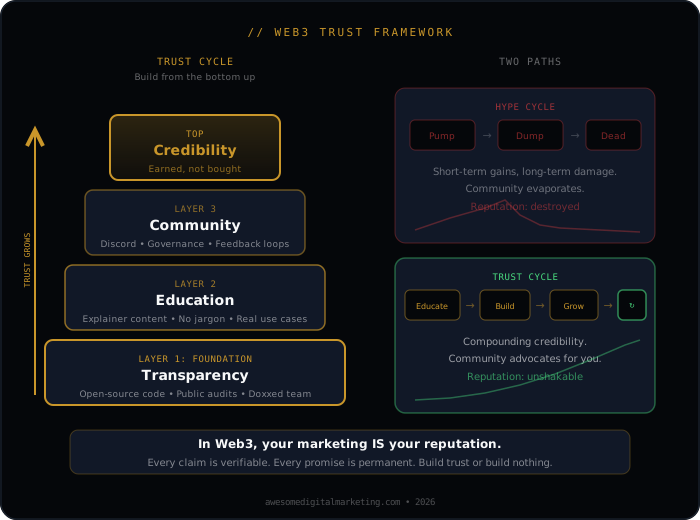
The projects that survive and grow aren’t running louder campaigns. They’re building marketing systems that work the same way good marketing has always worked: find the right audience, earn their trust, prove the value, measure what’s working.
Why Does Web3 Marketing Fail So Often?
The Hype-First Problem
Most crypto marketing starts with attention instead of trust. Influencer campaigns, airdrop mechanics, Discord raids — these tactics prioritize volume over quality. They attract speculators, not users. And speculators leave the moment the next shiny thing appears.
The deeper issue: web3 founders often treat marketing as a launch event rather than an ongoing system. You wouldn’t build a SaaS product with no onboarding, no retention loop, and no analytics. But that’s exactly what most token and protocol marketing looks like.
The Credibility Gap
Traditional businesses can lean on reviews, case studies, and referrals. Web3 companies operate in an environment where the average person associates crypto with scams, rug pulls, and volatility. That means every piece of your marketing has to work harder to establish trust — and the typical crypto playbook (anonymous teams, moon promises, countdown timers) does the opposite.
Building credibility in web3 requires the same fundamentals that work in any industry: clear messaging, consistent online presence, transparent reporting, and content that educates rather than hypes.
What Does Effective Web3 Marketing Actually Look Like?
Start with Positioning, Not Promotion
Before you run a single campaign, answer three questions:
- Who specifically needs this? Not “everyone in DeFi.” A lending protocol for small business treasury management is different from one for retail yield farming. Name your user.
- What problem does it solve in plain language? If you can’t explain the value without jargon, your marketing will only reach people who already understand the space — and they’re probably building their own thing.
- Why should anyone trust you? Team backgrounds, audit reports, on-chain transparency, real usage metrics. Lead with proof.
Most web3 companies skip this entirely and go straight to Twitter threads and Discord servers. That’s building a house on sand.
Content That Educates Instead of Shills
The crypto space is drowning in content that says nothing. “We’re building the future of finance” tells no one anything. What actually works:
- Technical explainers that show how your protocol works in concrete terms — what happens when a user deposits, what the smart contract does, where the yield comes from
- Comparison content that honestly positions you against alternatives (including CeFi alternatives your users might already trust)
- Use-case documentation showing real scenarios — not hypothetical “imagine if” stories, but actual examples of how current users interact with your product
This kind of content marketing does double duty: it ranks in search, it gets cited by AI models answering questions about your category, and it builds the trust that paid campaigns can’t buy.
Search and AI Visibility Matter More Than You Think
Here’s something most web3 marketers miss: people research crypto projects on Google and increasingly through AI tools like ChatGPT and Perplexity before they connect a wallet. When someone asks “what’s the best DeFi lending protocol for small businesses,” you want to be in that answer.
That means SEO and AI visibility aren’t optional — they’re how you reach users who are actively looking for solutions but haven’t joined any Discord yet. These are often your highest-quality leads because they have a real problem they’re trying to solve.
The content structure that works for AI citation — question-based headings, specific answers, clear comparisons — also happens to be the content structure that builds trust with skeptical readers. Win-win.
How Do You Build a Web3 Marketing System That Lasts?
Measurement Over Vanity Metrics
Discord member count means nothing if nobody’s using the product. Twitter followers mean nothing if they’re all other projects. The metrics that matter for web3 marketing:
- Wallet-to-user conversion rate — of the wallets that connect, how many complete a meaningful action?
- Content-to-signup attribution — which blog posts, which pages, which channels actually drive qualified interest?
- Retention and re-engagement — are users coming back? Are they expanding usage?
- Cost per qualified lead — not cost per wallet connection, cost per person who actually fits your target user profile
Building analytics and attribution that tracks these metrics is what separates web3 projects that scale from ones that run out of runway.
Email and CRM Still Work
This might be the most underrated channel in web3: email marketing. While every project fights for attention on Twitter and Discord, email gives you a direct, owned channel to communicate with people who’ve already expressed interest.
Newsletter subscribers who opted in because your content was useful are more valuable than 10,000 Discord members who joined for an airdrop. Build the list. Segment it. Send content that’s actually worth reading.
Your CRM should track the full journey — from first blog visit to newsletter signup to product usage. Most web3 companies have no idea where their users come from or what content influenced their decision. That’s flying blind.
Paid Advertising with Guardrails
Paid advertising in crypto is tricky — platform restrictions on Google and Meta change constantly, and the compliance landscape varies by jurisdiction. But it’s not impossible, and when done right, it reaches audiences that organic channels miss.
The key: advertise the problem you solve, not the token. “Reduce international payment fees by 80%” is an ad that works on Google. “Buy our governance token” is an ad that gets rejected — and even if it didn’t, it attracts the wrong audience.
What Mistakes Should Web3 Companies Avoid?
Paying for followers or engagement. It’s obvious to anyone paying attention, and it destroys credibility with the institutional partners and sophisticated users you actually want.
Treating community as marketing. Community management and marketing are related but different functions. Your Discord needs moderation, technical support, and genuine engagement — not just announcements and memes.
Ignoring traditional marketing fundamentals. The blockchain is new. Marketing isn’t. Positioning, messaging, segmentation, measurement — these principles are decades old because they work. AI-powered tools make them faster and more precise, but the fundamentals don’t change because you’re in web3.
Launching without a marketing system. A launch event is one day. Growth is every day after. Build the content engine, the email nurture, the analytics pipeline, and the feedback loop before you need them.
Where Should a Web3 Company Start?
If you’re pre-launch, start with positioning and content. Get the messaging right, build a content library that educates and ranks, and set up analytics from day one so you’re measuring from the start.
If you’re post-launch and struggling with traction, audit what you have. Where are your current users actually coming from? What content exists and how is it performing? Where are the gaps between your marketing activity and measurable results?
In either case, the answer isn’t more hype — it’s a system that connects strategy to content to measurement and proves what’s working every month.
See where you stand — check your AI visibility score.