Marketing Automation ROI: How to Measure What Actually Pays Back
There is a particular kind of frustration that comes from staring at a marketing dashboard full of green arrows and “record highs” while the business itself is not growing.
Impressions are up. Click-through rates are climbing. Your email open rate is “above industry average.” And yet, revenue is flat.
The problem is not always the marketing. Often, it is what the automation system is measuring.
Marketing automation ROI should answer one question: did the system create more qualified pipeline, revenue, retention, or time savings than it cost to build and run?
How Do You Measure Marketing Automation ROI?
Measure marketing automation ROI by comparing the business gain from automation against the full cost of the system. A useful working formula is:
Marketing automation ROI = (attributable gain - automation cost) / automation cost
The hard part is not the math. The hard part is defining “attributable gain” honestly.
For most service businesses, the inputs should include:
| ROI input | What to measure | Why it matters |
|---|---|---|
| Qualified pipeline | Leads that become qualified opportunities, not just form fills | Automation should improve lead quality and handoff, not only volume |
| Closed revenue | Deals or purchases tied back to the original source and nurture path | Revenue is the cleanest lagging signal when attribution is reliable |
| Speed to lead | Time from inquiry to first meaningful response | Faster routing and follow-up can protect demand that already exists |
| Sales-cycle movement | Days from lead to opportunity and opportunity to closed deal | Automation can create ROI by removing friction, even before volume grows |
| Retention or repeat purchase | Follow-up that increases repeat revenue, renewal, or reactivation | Some automation pays back after the first sale |
| Manual time saved | Hours removed from routing, follow-up, reporting, or handoff work | Labor savings count only when they change capacity or cost |
| System cost | Software, implementation, maintenance, creative, data cleanup, and reporting time | ROI is overstated if the cost side omits operations work |
Source checked: GA4 attribution paths report, GA4 Measurement Protocol, and Google Ads offline conversion imports. The measurement principle is consistent: define meaningful events, connect online and offline behavior where possible, and avoid treating an early click or form fill as the whole business outcome.
The next step is choosing metrics that connect to business outcomes and documenting what the measurement framework can and cannot establish.
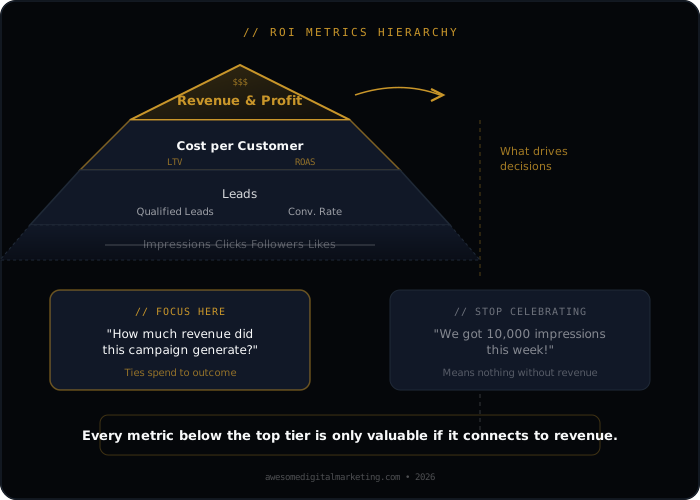
How Does ROAS Fit Into Marketing Automation ROI?
Return on Ad Spend (ROAS) compares attributed revenue with advertising cost. The formula is simple, but the attribution and revenue inputs still need scrutiny:
ROAS = Revenue from Ads / Cost of Ads
A reported ROAS of 4:1 means the selected attribution rule assigns four dollars in revenue for every dollar of included ad cost.
Campaign-level ROAS is useful, but it becomes incomplete when it omits customer status, margin, returns, time lag, or costs outside media spend.
What to measure instead:
- Blended ROAS: attributed revenue divided by total ad spend across selected channels, reported with a clear scope and date range
- New customer ROAS: revenue from newly acquired customers divided by the spend used to acquire them, when customer status is reliable
- Time-lagged ROAS: revenue evaluated after enough time has passed for the normal sales or repurchase cycle
Why Is Basic CPA Misleading?
Cost per acquisition gets attention, but raw CPA does not show the margin, retention, or quality associated with those acquisitions.
For example, a lower cost per acquisition can be less valuable when those customers retain poorly, while a higher-cost cohort may produce stronger lifetime value. The decision depends on verified customer outcomes, not the cheaper acquisition number alone.
Better questions to ask:
- What’s the CPA by lead quality tier? Segment your acquisitions by lifetime value, not just conversion event.
- What’s the CPA-to-LTV relationship? Compare acquisition cost with lifetime value, contribution margin, payback period, and the uncertainty in each estimate.
- Where in the funnel are you measuring? CPA for a form fill is very different from CPA for a closed deal. Make sure everyone on your team is talking about the same thing.
Lead Quality Patterns Worth Tracking
Not all leads are created equal, and your automation should be smart enough to know the difference.
- Source quality scoring: which channels consistently produce leads that become qualified opportunities or customers?
- Time-to-close by source: how does sales-cycle length vary by source, and what does that change economically?
- Engagement depth before conversion: compare measured content journeys with later qualification and revenue instead of assuming that more touches cause higher lifetime value
Should You Optimize for Cost Per Lead or Lead Quality?
Cost Per Lead can lead a team astray when lead quality is missing from the report. Optimizing only for the lowest CPL rewards whatever conversion is easiest to generate, even when it produces weak opportunities.
Low-friction offers can generate inexpensive form fills that never become qualified opportunities. Treat those responses as a separate conversion type instead of assuming that every lead has the same value.
A better framework:
- Qualified CPL: what does it cost to acquire a lead that meets the documented qualification criteria?
- CPL by intent level: separate informational demand from commercial intent when the source data supports that distinction.
- Revenue-connected CPL: work backward from qualified opportunities or closed deals using a documented attribution rule.
How Does Revenue-Focused Measurement Change Your Marketing?
Paid Media Feedback
When you shift from vanity metrics to revenue metrics, paid channels become one part of a larger feedback system. The goal is not to stare at platform dashboards. The goal is to learn which campaigns create qualified pipeline and customers after the CRM has time to show the outcome.
Budget decisions become clearer:
- Identify campaigns that produce cheap, low-quality leads
- Separate channels with stronger CPA-to-LTV or lead-to-close performance, even if the raw CPA is higher
- Use offline conversion data to compare form fills, qualified leads, converted leads, and closed revenue
Measurement configuration changes:
- Assign different values to different conversion types based on historical close rates
- Set conversion windows that match your actual sales cycle
- Keep paid-platform reports subordinate to CRM revenue, not the other way around
Funnel Optimization
The real power of marketing automation isn’t sending more emails. It’s understanding where your funnel leaks and fixing those gaps.
Key funnel metrics:
- Stage-to-stage conversion rates: where do prospects stall, and which stage deserves investigation?
- Time in stage: how long does a lead spend in each pipeline stage, and where does timing differ from the operating target?
- Drop-off analysis: where do people leave, and how does that pattern differ by source or qualification tier?
For a deeper look at where to optimize, see why more traffic is not always the answer. Fixing a verified conversion leak may be more useful than buying additional traffic.
How Should the Measurement Model Change by Business Type?
E-Commerce
For e-commerce, the metrics are more straightforward but the attribution is trickier.
- Track full customer lifetime, not just first purchase. A customer acquired at a loss on the first order can be highly profitable over 12 months.
- Segment by product category. Products with different prices, margins, return rates, and repurchase patterns need different economic benchmarks.
- Account for returns. A strong top-line ROAS can overstate performance when the campaign also produces a high return or cancellation rate.
- Monitor repeat purchase rate by acquisition source. Some channels produce one-time buyers. Others produce loyal customers. Plan accordingly.
B2B Services
B2B has longer sales cycles, which makes attribution harder and patience more important.
- Compare more than one attribution view. First-touch and last-touch answer different questions. Use them with CRM source history and measured touchpoints instead of presenting one model as objective truth.
- Track influenced pipeline, not just sourced pipeline. Marketing often doesn’t create the opportunity, but it influences whether it closes.
- Measure sales cycle length by source. If verified CRM data shows that one source closes faster, include that economic effect even when its lead volume is lower.
Agency Model
If you are running marketing for clients, the measurement model has to be understandable to people who do not watch the dashboards every day.
- Define success metrics before the campaign starts. Get alignment on what “working” looks like in writing.
- Report on leading and lagging indicators. Leading indicators such as qualified traffic and accepted leads can show movement. Lagging indicators such as recorded revenue and lifetime value provide stronger business evidence. Use both with consistent definitions.
- Connect marketing metrics to business metrics. A traffic increase needs context. Tie it to qualified leads, pipeline, or revenue where the data supports that connection.
What Does a Proper Tracking Foundation Look Like?
Google Analytics 4
Google Analytics 4 can be one part of the measurement system. Configure it around useful business events and connect it to other evidence where appropriate:
- Set up conversion events that map to actual business outcomes (not just page views)
- Enable enhanced measurement for scroll depth, outbound clicks, site search, and file downloads
- Connect paid-channel data only where it helps reconcile conversion and revenue signals
- Set up UTM conventions and enforce them across the team so inconsistent tagging does not fragment reporting
Conversion Signal Configuration
- Install conversion tags correctly. Test event names, values, consent behavior, and duplicate handling. If browser-only delivery leaves a material gap, review the server-side tracking walkthrough before selecting an implementation.
- Set up CRM feedback when a sales team closes deals. CRM integration makes the source and outcome connection easier to maintain so reporting can include qualified and closed lead events instead of stopping at form fills.
- Configure attribution windows around the actual sales cycle so early events are not mistaken for finished outcomes.
CRM Integration
Your CRM is where marketing metrics meet business reality.
- Map the measured journey from first touch to closed deal as part of the automation and lead-response system
- Push CRM stage changes into reporting and applicable conversion-import workflows so qualified and closed leads are not invisible
- Track revenue by original source so you can compare channel economics under a documented attribution rule, not just campaign delivery
Which Measurement Pitfalls Distort ROI?
Automation Without Strategy
The most expensive mistake in marketing automation is automating a broken process. If your lead nurture sequence isn’t converting, automating it just means you’re failing faster and at scale.
Before automating a customer-facing workflow, define the manual process, expected outcome, exceptions, and owner. Test a narrow version before scaling it.
Data Quality Issues
Garbage in, garbage out. Your metrics are only as good as your data.
- Duplicate records inflate your numbers
- Missing UTM parameters create attribution blind spots
- Inconsistent naming conventions make aggregation impossible
- Stale data (contacts who left the company, changed roles) skews your analysis
Schedule regular data hygiene. It’s not glamorous work, but it’s the foundation everything else sits on.
Over-Automation
Not everything should be automated. Some touchpoints require personal judgment, such as a well-timed phone call, a custom proposal, or a thoughtful follow-up.
Use automation for scale and consistency. Use humans for nuance and relationship-building. The best marketing programs do both.
Metric Obsession
There’s a point of diminishing returns with measurement. If you’re spending more time building dashboards than acting on what they tell you, you’ve gone too far.
Pick 5-7 metrics that genuinely drive decisions. Track those religiously. Review everything else quarterly. Kill any report that nobody acts on.
Where Should You Start?
Here’s a practical starting point:
-
Audit your current metrics. List every metric you’re tracking. For each one, ask which decision it supports. Consider removing measures that do not inform an operating or investment decision from the primary view.
-
Define your core KPIs. Choose a small set that represents spend, demand, sales progress, and business outcomes for your model. Document how each one is calculated.
-
Fix your tracking foundation. Verify that analytics, ad platforms, forms, calls, and the CRM preserve the fields needed for the decisions you plan to make. Scope the work before assuming it is a one-afternoon task.
-
Build a 30-60-90 review cadence. Look at leading indicators weekly, conversion metrics monthly, and ROI metrics quarterly. Match the review frequency to the metric’s natural cycle.
-
Start with one decision area. Choose a high-priority channel or funnel stage, improve the measurement, and evaluate whether it changes decisions before expanding.
The goal is not to measure more. It is to measure what matters, act on what the evidence supports, and build a feedback loop between marketing activity and business outcomes. A governed analytics and reporting setup can connect content marketing, reputation work, paid media, and lead response to qualified pipeline and revenue where the data allows.
Want to see what your visibility system may be missing? Run a free AI Visibility scan and use the findings as one input to the broader measurement audit.