Why Most Agency White-Label Partnerships Fail (And How to Fix Yours)
The pitch sounds perfect: partner with a white-label provider, add AI, SEO, or automation to your service stack, and scale your agency without hiring a full team. More services, higher margins, no added headcount.
Then reality hits. The quality is inconsistent. The communication is slow. Your clients start asking questions you can’t answer. Six months later, you’re either doing the work yourself or apologizing for the white-label team’s output.
Most agency white-label partnerships fail. But the ones that work create a genuine competitive advantage. The difference comes down to how the partnership is structured, not whether white-labeling itself is a good idea.
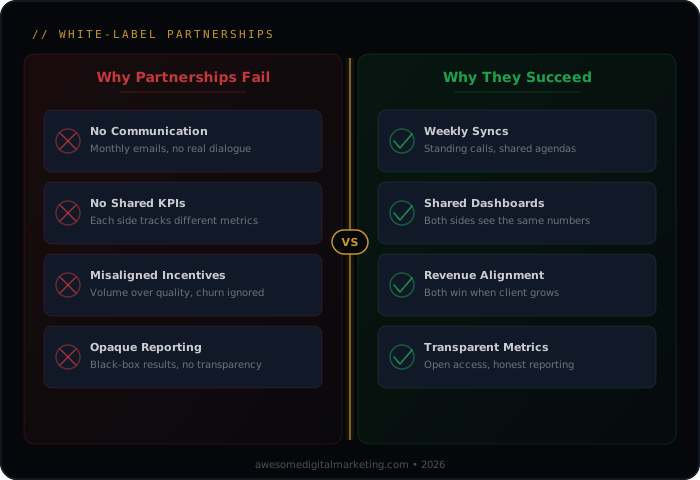
Why Do Most White-Label Partnerships Fail?
The Communication Gap
The most common failure point isn’t quality — it’s communication. Your client tells you what they need. You translate it for the white-label partner. They interpret your translation and produce something. You review it and send corrections. They revise. By the time the deliverable reaches the client, it’s been through a game of telephone that strips out nuance and context.
Every handoff introduces friction. The more steps between the client’s need and the final deliverable, the more likely something gets lost.
The Accountability Problem
When something goes wrong — a campaign underperforms, a deadline slips, or quality drops — who’s responsible? In most white-label arrangements, the answer is murky. The agency blames the white-label partner. The partner says they followed the brief. The client just knows they didn’t get what they paid for.
Clear accountability requires clear ownership. Most partnerships don’t define this until something breaks.
The Expertise Gap
Many agencies white-label services they don’t deeply understand. They sell AI visibility or marketing automation because clients are asking for it, but they can’t evaluate the quality of what the partner delivers. If you can’t tell good work from bad work, you can’t manage quality — and your clients will figure that out eventually.
The Margin Squeeze
White-label pricing that looks attractive at signing becomes a problem at scale. If the partner charges 60% of what you bill the client, your margin on those services is thin. When scope creep happens (and it always does), that margin evaporates. Suddenly your most profitable-looking service line is breaking even or losing money.
What Does a Successful Agency Partnership Look Like?
Shared Systems, Not Separate Silos
The partnerships that work share tools and systems rather than just exchanging deliverables. When both parties operate in the same CRM, project management tool, or analytics platform, the communication gap shrinks dramatically.
The ideal setup: your white-label partner works inside your systems, sees the same client data you see, and delivers work directly into your workflow — not as attachments in an email.
Defined Swim Lanes
Successful partnerships clearly define who owns what:
- Strategy: Usually the agency (you know the client best)
- Execution: Usually the partner (that’s why you hired them)
- Client communication: Always the agency (the client relationship is yours)
- Quality control: Shared, with clear standards documented
- Reporting: Generated by the partner, reviewed and delivered by the agency
When everyone knows their lane, fewer things fall through the cracks.
Transparent Pricing with Room for Both
The pricing model needs to work for both sides. The partner needs to be paid enough to do quality work. The agency needs enough margin to justify the management overhead. The client needs to receive value worth what they’re paying.
Models that work:
- Fixed monthly retainer per client with clear scope definitions
- Tiered pricing that decreases per-client cost as volume increases
- Revenue sharing on new business generated through the partnership
Models that don’t:
- Per-deliverable pricing with vague scope (guaranteed scope creep arguments)
- Percentage of client billing without visibility into what you charge
Mutual Skin in the Game
The best partnerships have consequences for both sides. If the partner’s work loses a client, the partner loses revenue too. If the agency fails to provide adequate briefs or client context, the agency absorbs the cost of revisions.
Partnerships without consequences for poor performance are just vendor relationships with a nicer name.
How Should Agencies Evaluate White-Label Partners?
Test with a Real Project First
Before committing to a partnership, run a paid pilot project. Not a demo. Not a case study from their website. A real project with real client requirements and real deadlines.
Evaluate:
- Quality of the work itself — does it meet your standards without heavy revision?
- Communication — do they ask smart questions? Are they responsive?
- Timeline adherence — did they deliver on time, or did you have to chase?
- Problem handling — when something needed to change, how did they respond?
One project tells you more than a dozen sales calls. For the broader picture on evaluating any marketing partnership, see our guide on how to choose a digital marketing agency.
Verify the Expertise
Ask technical questions about their service area. If they’re providing SEO and AI visibility services, they should be able to explain their audit methodology, their approach to schema markup, and how they measure AI citation potential. If they’re providing analytics and reporting, they should know GA4 Measurement Protocol, multi-touch attribution models, and CRM integration approaches.
Vague answers like “we use industry best practices” are a red flag. Specific, detailed answers indicate genuine expertise.
Check Their Stack
What tools and platforms do they use? Are they compatible with yours? Can they work inside your systems, or do they require everything to flow through their own tools?
The best partners are stack-agnostic — they adapt to your tools and workflows rather than forcing you to adapt to theirs.
Talk to Their Other Agency Partners
Ask for references — not from their clients, but from other agencies they white-label for. Those agencies will tell you the truth about quality consistency, communication, and what happens when things go sideways.
What Services Are Best Suited for White-Label?
Not every service white-labels well. The best candidates are services that are:
- Process-driven — clear inputs produce predictable outputs
- Measurable — quality can be objectively assessed
- Scalable — the partner can handle volume without quality degradation
- Specialized — requires expertise your team doesn’t have internally
Good white-label candidates:
- Technical SEO audits and implementation
- Content marketing and content production
- Paid advertising campaign management
- Email marketing automation setup and management
- Analytics setup and reporting
Risky white-label candidates:
- Brand strategy and messaging (too subjective, too close to the client relationship)
- Client-facing presentations and consultations (breaks the white-label model)
- Crisis communication or reputation repair (too time-sensitive for handoffs)
How Do You Build a Partnership That Scales?
Start with One Service, One Client
Don’t white-label five services simultaneously. Pick the service where the quality/expertise gap is clearest, test it with one client, and expand only after proving the model works.
Document Everything
Create a partnership playbook that covers:
- Communication protocols (response times, escalation paths)
- Briefing templates (what information the partner needs for each deliverable)
- Quality standards (what “done” looks like, with examples)
- Revision policies (how many rounds, what constitutes a revision vs. scope change)
- Reporting cadences and formats
Build Review Loops
Monthly partnership reviews that cover:
- Client satisfaction scores
- Quality metrics (revision rates, deadline adherence)
- Financial performance (margin by client)
- Communication effectiveness
- Pipeline for new opportunities
These reviews catch problems early and create space for continuous improvement.
Plan for Growth
If the partnership works, what does scaling look like? Can the partner handle 3x the current volume? 10x? At what point do you need additional partners or internal hires?
The best time to have this conversation is before you need the capacity — not when a new client is waiting.
The Bottom Line
White-label partnerships fail when they’re treated as vendor relationships — transactional, arm’s-length, and undermanaged. They succeed when they’re treated as true partnerships — with shared systems, clear accountability, mutual investment, and ongoing communication.
The agency model is evolving. The agencies that grow aren’t the ones that try to do everything internally. They’re the ones that build excellent partnerships, maintain quality control, and keep the client relationship at the center of everything.
An AI-powered marketing partner should feel like an extension of your team — not a black box you throw briefs into and hope for the best.
Want to explore a partnership? Get in touch to discuss how we work with agencies.