The Nonprofit Marketing Coalition: A New Model for Growth
Nonprofits face a frustrating paradox: the organizations that need marketing the most are often the ones that can afford it the least. Enterprise-level tools, professional strategy, skilled execution — these aren’t luxuries. They’re the difference between scraping by and actually growing your impact. But they come with enterprise-level price tags.
What if the answer isn’t finding cheaper tools, but sharing better ones?
Why Does Traditional Nonprofit Marketing Fall Short?
Most nonprofits operate their marketing in isolation. A small staff (often one person wearing five hats) tries to manage email campaigns, social media, donor communications, event promotion, and community outreach — usually with a shoestring budget and donated tools that don’t quite fit.
The result is predictable:
- Inconsistent communication. Donors hear from you when there’s an ask, then silence until the next ask. The relationship feels transactional because the organization doesn’t have bandwidth for anything else.
- Underinvested technology. Free-tier tools with limited features. No CRM, or a CRM that’s barely maintained. Analytics that nobody has time to check.
- Reactive strategy. Marketing happens in response to immediate needs (the gala is next month, we need to send an email) rather than as part of a sustained growth plan.
- Talent gaps. You need a designer, a copywriter, a data analyst, and a strategist. You have one marketing coordinator and a volunteer who knows Canva.
None of this is a criticism of the people doing the work. They’re doing incredible things with almost nothing. The model itself is the problem.
What Is a Nonprofit Marketing Coalition?
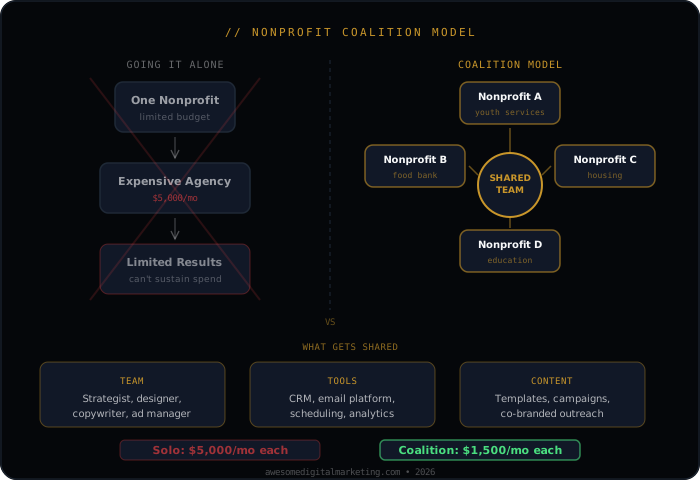
A nonprofit marketing coalition is a shared-resource model where multiple nonprofits pool a portion of their marketing budgets to access tools, talent, and strategy that none of them could afford alone.
Think of it like a co-op: individual organizations maintain their own brand identity and messaging, but share the underlying infrastructure that powers effective marketing.
What Gets Shared
Technology stack. Instead of five nonprofits each paying for a basic CRM, the coalition invests in one professional-grade platform that serves all members. Email marketing, donor management, analytics, automation — enterprise tools at a fraction of the individual cost.
Strategic expertise. A coalition can afford to retain marketing strategists, data analysts, and content professionals who serve all member organizations. Each nonprofit gets access to skills they couldn’t justify hiring for individually.
Knowledge and best practices. What works for donor acquisition at one organization might apply to another. A coalition creates a structured way to share learnings — not just informal conversations, but documented playbooks, shared templates, and collaborative problem-solving.
Content and creative resources. Shared access to designers, photographers, videographers, and writers. A professional brand presence becomes achievable when the cost is distributed.
What Stays Independent
Brand identity. Each organization maintains its own voice, visual identity, and messaging. The coalition supports execution — it doesn’t homogenize the members.
Donor relationships. Your donors are your donors. Data stays owned by each organization. The coalition provides better tools to manage those relationships, not shared access to them.
Strategic priorities. Each nonprofit sets its own goals and priorities. The coalition provides resources to execute on those priorities more effectively.
How Does a Marketing Coalition Work in Practice?
Formation
A coalition starts with a small group of nonprofits — ideally three to five organizations with complementary missions (not competing for the same donors). They might serve different populations, address different aspects of the same issue, or operate in adjacent spaces.
The key requirement: a willingness to invest collectively in marketing infrastructure rather than going it alone with minimal resources.
Shared Technology
The coalition selects and maintains a shared technology platform. This typically includes:
- CRM and donor management — Each organization has its own workspace within a shared platform. Data is separate; the subscription cost is shared.
- Email marketing and automation — Professional-grade email tools with proper deliverability, segmentation, and automation capabilities.
- Analytics and reporting — Shared dashboards that help each organization understand what’s working and where to invest.
- Design and content tools — Shared subscriptions to design platforms, stock assets, and content management systems.
Shared Talent
Instead of each nonprofit hiring a part-time marketing person, the coalition retains shared professionals:
- A marketing strategist who works with each organization on quarterly planning and campaign design.
- A content creator who produces newsletters, social content, and donor communications across the coalition.
- A data analyst who monitors campaign performance and identifies optimization opportunities for all members.
Each organization gets consistent, professional marketing support without bearing the full cost of these roles.
Knowledge Sharing
Regular coalition meetings (monthly or quarterly) where members share:
- What campaigns worked and why.
- Donor engagement strategies that drove results.
- Technology tips and workflow improvements.
- Challenges they’re facing and collaborative problem-solving.
This creates a compounding advantage. Every insight benefits all members, and the collective knowledge grows faster than any single organization could develop on its own.
How Do You Start a Nonprofit Marketing Coalition?
If the coalition model resonates, here’s a realistic path to exploring it.
Phase 1: Explore (Months 1–2)
- Identify two to four nonprofits in your community with complementary missions.
- Have honest conversations about current marketing challenges, budgets, and willingness to collaborate.
- Assess compatibility: shared values, similar organizational maturity, commitment to investing in marketing.
Phase 2: Define (Months 3–4)
- Agree on what gets shared and what stays independent. Document this clearly.
- Evaluate technology platforms that support multi-tenant setups.
- Develop a budget model: what does each organization contribute, and what do they receive?
- Establish governance: how are decisions made? How are disputes resolved? Who manages the shared resources?
Phase 3: Build (Months 5–8)
- Implement the shared technology stack, starting with the highest-impact tool (usually CRM or email marketing).
- Onboard shared talent — start with one role (a strategist or content creator) and expand based on results.
- Migrate each organization’s existing data and workflows to the shared platform.
- Run initial campaigns using the new infrastructure.
Phase 4: Optimize (Ongoing)
- Review performance quarterly. Is each organization getting measurable value from the coalition?
- Adjust the resource allocation based on what’s working.
- Consider expanding — adding new member organizations or new shared capabilities.
- Document and share learnings so the model can be replicated by other communities.
Investment Structure
A coalition model works financially because it turns fixed costs into shared costs.
Individual model: Each nonprofit spends a small amount on basic tools and gets basic results. The total spend across five organizations might be substantial, but each one is operating with limited capability.
Coalition model: The same total investment — pooled — buys professional-grade tools and shared talent that dramatically improve capability for every member.
The specifics depend on the organizations involved, their budgets, and their needs. But the principle is straightforward: collective investment in shared infrastructure produces better outcomes than fragmented spending on individual workarounds.
Making It Sustainable
- Start lean. Don’t over-build the coalition infrastructure. Start with one shared tool and one shared resource. Prove the model works before expanding.
- Measure impact. Each organization should track specific outcomes — donor growth, engagement rates, fundraising results — so the coalition can demonstrate its value.
- Plan for turnover. Organizations may join or leave. Build the model so it’s resilient to membership changes.
- Maintain accountability. Regular reporting on how shared resources are being used and what results they’re producing. Transparency builds trust.
Why Does This Model Matter for Nonprofits?
Nonprofits exist to create impact. Every dollar spent on marketing is a dollar that could have gone directly to the mission. That creates a constant tension — and often leads to underinvesting in the marketing that would grow the organization’s capacity to serve.
The coalition model doesn’t eliminate this tension, but it changes the equation. By sharing costs and expertise, each organization gets more marketing capability per dollar invested. Better marketing means more donors, more awareness, more support — and ultimately, more impact.
It’s not a silver bullet. Building a coalition takes effort, trust, and patience. But for nonprofits willing to invest in collaboration, it offers a path to marketing capability that most couldn’t achieve alone. A shared content marketing strategy, connected analytics and reporting, and AI-powered marketing tools make the coalition model even more powerful — giving every member access to systems that amplify their reach without duplicating effort.
Want to see where your nonprofit’s digital presence stands? Run a free AI Visibility scan — 22 checks, 5 pillars, results in 30 seconds.