Content Marketing That AI Models Actually Cite
You can publish a hundred blog posts and still be invisible to AI. The problem isn’t volume — it’s structure.
AI models like ChatGPT, Perplexity, and Google AI Overviews don’t reward content the way traditional search engines do. They don’t care about keyword density or backlink counts. They’re looking for content that answers questions clearly, demonstrates genuine expertise, and is structured in a way they can parse and cite. To understand how AI search is changing who gets found, you need to rethink content from the ground up.
Most businesses are still creating content for 2019 SEO. Here’s how to create content for 2026 AI visibility.
Why Does AI Ignore Most Content?
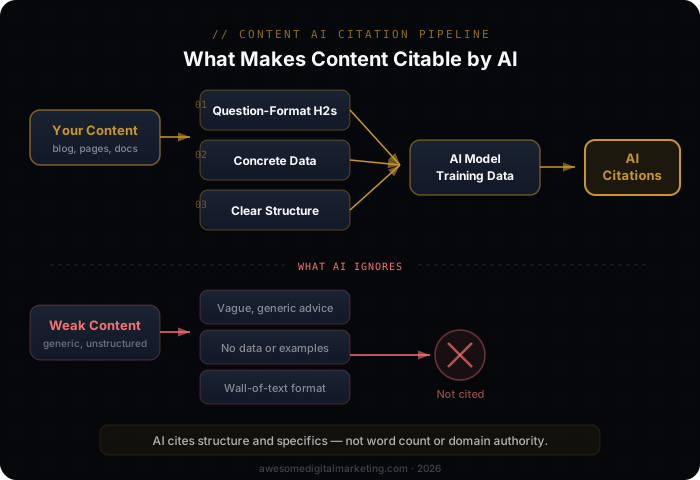
The Citability Problem
When an AI model generates a response, it draws from content it considers authoritative and citable. Most business content fails this test because it’s:
The Citability Problem
When an AI model generates a response, it draws from content it considers authoritative and citable. Most business content fails this test because it’s:
- Too generic. “Marketing is important for your business” doesn’t tell an AI model anything it can use in a recommendation.
- Too vague. Content without specific data, frameworks, or actionable advice doesn’t meet the threshold for citation.
- Poorly structured. AI models parse content by headings, lists, and paragraph structure. Walls of text without clear organization are difficult for AI to extract useful information from.
- Lacking entity clarity. If your content doesn’t clearly identify who you are, what you do, and where you do it, AI models can’t connect it to relevant queries.
How AI Models Select Sources
AI models don’t rank content — they cite it. The selection criteria are different:
- Specificity. “The average cost of HVAC repair in Denver ranges from $150-$450 for common issues” is citable. “HVAC repair costs vary” is not.
- Authority signals. Content from established businesses with consistent online presence, reviews, and citations gets prioritized.
- Structural clarity. Question-based headings followed by clear, direct answers align with how AI models process and retrieve information.
- Freshness. Current content with recent dates signals active expertise. Outdated content gets deprioritized.
How Do You Structure Content for AI Citation?
Question-Based Headings
This is the single most impactful structural change you can make. AI models process queries as questions. When your headings match those questions, your content becomes directly citable.
Instead of: “Our Marketing Approach” Write: “How Does AI-Powered Marketing Work?”
Instead of: “Service Area Information” Write: “What Areas Do You Serve in Denver?”
Instead of: “Pricing Details” Write: “How Much Does [Service] Cost?”
Every H2 on your page should be a question someone might ask an AI model. The paragraph immediately after should provide a clear, direct answer.
The Answer-First Pattern
AI models pull from the first substantive statement after a heading. Lead with the answer, then expand.
Weak structure:
There are many factors to consider when evaluating marketing agencies. Budget, experience, industry focus, and technology stack all play a role. Based on these considerations, a good starting point is…
Strong structure:
A good marketing agency should demonstrate measurable results tied to revenue, not just traffic or impressions. Here’s what to evaluate…
The second version gives the AI model a clear, citable statement immediately. The supporting detail follows for human readers who want depth.
Entity Definitions
Somewhere on your site — ideally on your about page and reinforced through schema markup — you need to clearly define your business entity:
- Who you are — business name, founding year, key people
- What you do — specific services, not generic descriptions
- Where you operate — service area, physical address
- What makes you different — specific differentiators, not “we’re passionate about marketing”
- Credentials — certifications, partnerships, notable clients
AI models use this entity data to determine whether to recommend you for specific queries. Without it, you’re just another anonymous source.
Structured Data Markup
Schema markup is the machine-readable version of your content. At minimum:
- Organization/LocalBusiness schema on your homepage
- Service schema on each service page
- Article/BlogPosting schema on every piece of content
- FAQ schema for question-and-answer content
- BreadcrumbList schema for site navigation context
Schema doesn’t guarantee AI citations, but without it, you’re making AI models work harder to understand your content — and they’ll choose easier-to-parse alternatives.
What Types of Content Get Cited Most?
Definitive Guides
Comprehensive guides on specific topics perform well because they contain multiple citable statements. A 2,000-word guide on “email deliverability setup” contains dozens of answer-ready passages that AI models can draw from for various related queries.
This is why your content marketing strategy should prioritize depth over frequency. One authoritative guide is worth more than ten surface-level posts.
Data-Backed Analysis
Content that includes specific data, benchmarks, or research gets cited more frequently. AI models treat quantitative claims as more authoritative than qualitative statements.
“Businesses that implement call tracking see a 25% improvement in lead attribution” is dramatically more citable than “call tracking helps you understand where your leads come from.”
How-To and Process Content
Step-by-step guides with clear numbered instructions are highly citable because AI models can extract and present the process clearly. Technical guides — like our post on GA4 funnel tracking — perform well because they contain specific, actionable instructions.
Comparison and Evaluation Content
“Custom website vs. platform-based: which should you choose?” content aligns with how people ask AI for advice. Balanced evaluations with clear recommendations based on specific criteria are exactly what AI models look for.
Local and Industry-Specific Content
“Best practices for HVAC marketing in Denver” is more citable for relevant queries than “best practices for marketing.” Specificity signals expertise. AI models serve specific answers to specific questions.
How Do You Measure Content Performance for AI?
Traditional content metrics (pageviews, time on page, bounce rate) don’t capture AI visibility. Add these to your measurement framework:
AI Citation Monitoring
Regularly test whether AI models cite your content for relevant queries. Ask ChatGPT, Perplexity, and Google AI Overviews questions your content answers and check whether your business or content appears in the response.
Impressions Without Clicks
In Google Search Console, monitor queries where you appear but get zero clicks. This may indicate that your content is being consumed through AI Overviews without generating a visit — which means you need to optimize for the citation itself, not just the click.
Structured Data Validation
Use Google’s Rich Results Test and Schema Markup Validator to ensure your structured data is error-free and comprehensive. Incomplete schema limits your AI visibility.
Content Depth Scoring
Track word count, heading structure, question coverage, and internal linking for each piece of content. Content under 800 words rarely achieves AI citation for competitive topics.
What Should Your Content Calendar Look Like?
A content strategy built for AI visibility looks different from traditional content marketing:
Monthly Output
- 1 comprehensive guide (1,500-2,500 words) targeting a key topic cluster
- 2 supporting articles (800-1,200 words) that link to and expand on the guide
- 1 data-backed analysis or case study with specific metrics and results
- Ongoing updates to existing content — refresh data, add new sections, update dates
Topic Selection
Choose topics based on:
- Questions your audience actually asks (check your call logs, emails, and sales conversations)
- Queries AI models currently answer without citing your business
- Gaps in your competitor’s content coverage
- Topics where you have genuine expertise and specific data
Internal Linking
Every piece of content should link to related service pages and other relevant content. This builds topical authority and helps AI models understand the relationships between your content. For a deeper look at how to structure your knowledge so AI systems actually retain and reference it, see QNTx Labs’ guide on building a knowledge system for AI.
Your AI-powered marketing system should connect content creation to lead capture, so every article feeds your pipeline — not just your traffic reports. For a behind-the-scenes look at how AI transforms real client marketing work, see how AI is actually used in client marketing.
Where Should You Start?
If you’re starting from scratch or rebuilding your content strategy for AI visibility:
- Audit your existing content. Which pieces already have question-based headings and clear answers? Which need restructuring?
- Implement schema markup. Start with Organization and Service schema on your main pages.
- Rewrite your top 5 pages with question-based headings and answer-first structure.
- Create one comprehensive guide on your primary service topic.
- Test with AI models. Ask ChatGPT and Perplexity questions about your industry and see whether your content appears.
Content marketing that AI models actually cite isn’t about gaming a system. It’s about creating genuinely useful, well-structured content that’s easy for both humans and machines to understand. The businesses that do this well will capture an increasingly large share of attention as AI search grows.
Want to see how your content performs for AI? Run a free AI Visibility scan — see your content structure score and citation potential.