Beyond the Hype: Practical Applications of AI in Modern Marketing
Every week there’s a new AI marketing tool promising to revolutionize your business overnight. Most of them won’t. But buried under the hype, there are genuine applications of AI that are quietly transforming how smart businesses attract and convert customers.
The difference between businesses that benefit from AI and those that waste money on it comes down to one thing: practical implementation. Not chasing trends — solving real problems.
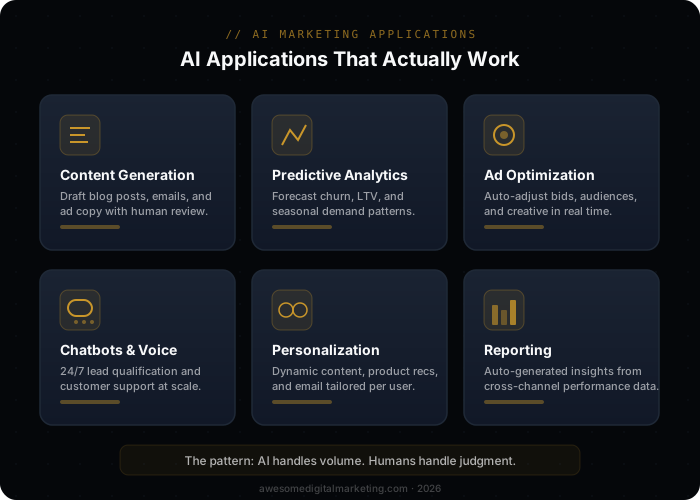
What AI Applications Actually Drive Results?
Smart Lead Generation
The old way: cast a wide net, hope for the best, waste budget on unqualified traffic. AI changes the math by helping you identify which prospects are most likely to convert — before you spend money reaching them.
What this looks like in practice:
- Predictive lead scoring — Instead of treating every form submission equally, AI models analyze behavioral patterns to surface which leads deserve immediate follow-up and which need more nurturing.
- Audience modeling — Feed your best customer data into lookalike models that find similar prospects. The targeting gets sharper over time as the model learns what “good fit” actually means for your business.
- Intent signals — AI tools can monitor search behavior, content consumption, and engagement patterns to identify prospects who are actively researching solutions you provide.
The key insight: AI doesn’t replace your sales team’s judgment. It gives them better information to work with so they spend time on the right conversations.
Content Optimization
Creating content is expensive. AI helps you get more value from every piece you produce.
- Topic research — AI can analyze search patterns, competitor content, and audience questions to identify gaps in your content library. Instead of guessing what to write about, you’re responding to actual demand.
- Performance analysis — Which headlines drive clicks? Which content structures keep people reading? AI can surface patterns across your content that would take a human analyst weeks to identify.
- Personalization at scale — Serve different content variations to different audience segments based on their behavior and preferences. One piece of content, multiple relevant experiences.
What AI won’t do: write content that sounds like a human who genuinely understands your industry. Use it to inform your content strategy, not replace your voice.
Campaign Automation
This is where AI earns its keep for most businesses. The tedious, repetitive parts of campaign management — bid adjustments, audience refinements, send-time optimization — are exactly the kind of work AI handles well.
- Ad spend optimization — AI can adjust bids across thousands of keywords in real time, responding to performance signals faster than any human could. This is where paid advertising management and AI overlap most powerfully.
- Email timing and segmentation — Instead of blasting your entire list at 10am Tuesday, AI can determine when each subscriber is most likely to engage and segment your messaging accordingly. Modern email marketing platforms use AI for send-time optimization and predictive list management.
- A/B testing at scale — Test more variables, faster. AI can run multivariate tests across subject lines, creative, audiences, and timing simultaneously, converging on winning combinations.
How Should You Implement AI in Your Marketing?
Start With an Honest Assessment
Before you buy anything, answer these questions:
- What’s your biggest bottleneck? Is it generating leads, nurturing them, closing them, or retaining customers? AI should address your actual constraint, not a theoretical one.
- How clean is your data? AI is only as good as the data it learns from. If your CRM is a mess, fix that first.
- What does your team actually use? The fanciest tool in the world is worthless if your team won’t adopt it. Start with something that integrates into existing workflows.
Tool Selection Principles
- Solve one problem first. Don’t try to “AI everything” at once. Pick your highest-impact bottleneck and find a tool that addresses it specifically. The SYNTAX framework from QNTx Labs provides a systematic approach to this — structured AI collaboration that compounds instead of scattering effort. For the full methodology behind selecting the right AI marketing strategy, see the SYNTAX deep-dive.
- Demand measurable outcomes. If a vendor can’t explain exactly how you’ll measure success, that’s a red flag.
- Check integration requirements. A standalone AI tool that doesn’t talk to your CRM, email platform, or analytics creates more work, not less.
- Consider the learning curve. Your team needs to actually use this thing. Simpler tools that get adopted beat powerful tools that gather dust.
What Are the Most Common AI Marketing Mistakes?
Over-Automation
Automating everything sounds efficient until a customer gets a tone-deaf automated response during a service issue. AI should handle the routine so your team can focus on the moments that require a human touch — not replace those moments entirely.
The rule: If a customer interaction involves emotion, complexity, or high stakes, a human should be involved. Automate the predictable. Personalize the important.
Tool Overload
It’s tempting to stack AI tools on top of each other. Lead scoring here, chatbot there, content optimizer over there. Before long, you’re spending more time managing tools than doing marketing.
The rule: Every tool needs to justify its existence with measurable impact. If you can’t point to specific outcomes it drives, cut it.
Ignoring Data Quality
This is the most common failure point. You implement a shiny AI tool, feed it garbage data, and wonder why the results are disappointing. Duplicate contacts, outdated information, inconsistent formatting — AI amplifies these problems.
The rule: Budget time for data cleanup before any AI implementation. It’s not glamorous, but it’s the difference between success and wasted investment.
What ROI Can You Expect from AI Marketing?
Investment Considerations
Be honest about the full cost of AI adoption:
- Software licensing — Monthly or annual fees for the tools themselves.
- Implementation time — Setup, integration, and configuration aren’t free. Budget real hours for this.
- Training — Your team needs to learn the tools. This takes time away from other work.
- Ongoing optimization — AI tools aren’t set-and-forget. Someone needs to monitor performance and adjust.
Expected Returns
The businesses that see meaningful returns from AI marketing share common traits:
- They started with a clear, specific problem to solve.
- They had reasonably clean data to work with.
- They measured results against a defined baseline.
- They gave the implementation enough time to mature (most AI tools need data to improve — results get better over months, not days).
Where you’ll typically see the fastest impact: reducing manual work in campaign management, improving lead qualification accuracy, and identifying content opportunities you’d otherwise miss.
Where results take longer: predictive modeling, personalization engines, and anything that requires substantial training data.
What Should Your First 30 Days with AI Marketing Look Like?
Week 1: Audit and Assess
- Document your current marketing stack and workflows.
- Identify your top three time-consuming manual processes.
- Audit your data quality — how clean is your CRM? Your email list? Your analytics setup?
- Set a specific, measurable goal for what AI should improve.
Week 2: Research and Select
- Based on your assessment, research tools that address your specific bottleneck.
- Request demos and trial periods. Test with your actual data, not their demo data.
- Talk to businesses similar to yours who use the tool. Vendor case studies are marketing materials — peer feedback is reality.
Week 3: Implement and Integrate
- Set up your chosen tool with proper integrations to your existing stack.
- Configure tracking so you can measure impact against your baseline.
- Train your team on the basics — focus on the workflows they’ll use daily.
Week 4: Measure and Adjust
- Review initial performance data (with realistic expectations — one week of data is directional, not conclusive).
- Identify friction points in adoption. What’s confusing? What’s being ignored?
- Document what’s working and what needs adjustment.
- Plan your optimization cadence for the next 90 days.
The Bottom Line
AI in marketing isn’t magic and it isn’t hype — it’s a set of tools that, applied thoughtfully, can make your existing marketing work significantly harder. The businesses winning with AI aren’t the ones with the most tools. They’re the ones who started with a clear problem, implemented deliberately, and measured honestly. To see how modern AI tools amplify traditional marketing fundamentals across every channel, start with the principles that already work — then let AI scale them.
Skip the hype cycle. Focus on the fundamentals. Let AI amplify what already works. When AI is connected to your analytics and reporting, you stop guessing what’s working and start knowing.
Want to see how AI fits into your marketing? Run a free AI Visibility scan — 22 checks, 5 pillars, results in 30 seconds.